 We started trying to manage fisheries using science-based principles more than 150 years ago. Today, despite great improvements, we are still struggling to manage fisheries well. Perhaps the greatest missing piece in our understanding is an ability to accurately link the number of spawning adult fish with the number of their offspring that survive to replenish the population. Recognition that individual differences play a role in the dynamics of natural populations promises to greatly improve fisheries management.
A classic example of our inability to effectively manage harvested fish populations is the collapse of the northwest Atlantic cod fishery. Despite being managed using best practices, in 1992 the number of cod had collapsed to less than 1% of the number present in 1977. A moratorium was declared to allow the fishery to recover. It was predicted to rebound within a decade, but twenty years on and cod stocks are still at less than 5% of their previous levels and some authorities suggest the fishery may never fully recover.
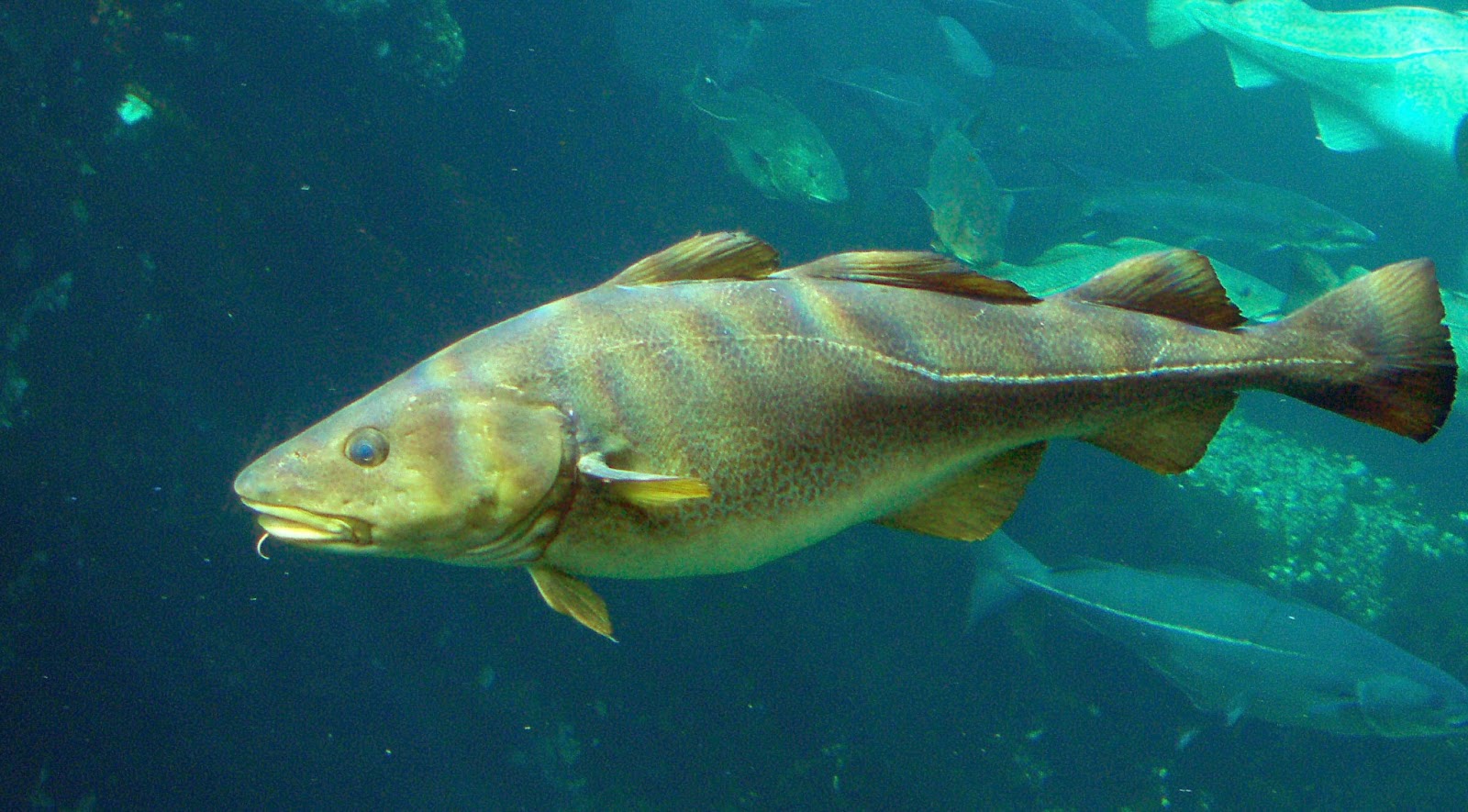 |
| An Atlantic cod, Gadus morhua (photo Wikipedia). |
Predation and starvation are the two greatest sources of mortality for fish eggs and larvae. Neither of these is random. Bigger, better provisioned eggs are more likely to produce larvae that survive the larval period and replenish the adult population. There are also characteristics of the parents that effect the survival of their offspring, such as when and where they choose to spawn, and how big or old they are.
 |
| Predators of fish eggs and larvae are numerous. Jellyfish, like Aurelia aurita, are among them (photo Wikipedia). |
Good evidence to support these hypotheses has only emerged recently, with the arrival of technology that can provide long-term measurements over large spatial scales. Platt et al. (2003) combined data from remote-sensing satellites with long-term population surveys of haddock, Melanogrammus aeglefinus. Their data showed that when the peak of spawning occurred after the peak in the spring plankton bloom, survival of larval haddock was much higher.
Beaugrand et al. (2003) used data from continuous plankton sampling devices that are opportunistically attached to merchant ships. The devices gave them not only plankton abundance data, but allowed them to measure the size of prey species. Data on cod, Gadus morhua, were obtained from two largely overlapping population surveys. Like Platt et al., they found that the timing of the plankton bloom was important for larval survival, but they also found that the abundance and average size of prey species were important too.
Predation was recognised early on as an important factor influencing the survival of fish larvae. However, research into its effects on fish populations didn't begin in earnest until the 1970's. The research showed that bigger, faster growing larvae were more likely to survive that larval period. Several, subtly different mechanisms were proposed to explain this pattern and are often combined into the 'growth-predation' hypothesis.
Testing the growth-predation hypothesis in the wild has proved tricky. But, fish have structures in their ears called otoliths that lay down growth rings a bit like the growth rings in a tree. Because the growth rings in otoliths are laid down daily in many fish species they can be used as proxy measurements of size and growth. Several studies have used otoliths to calculate size and growth rates and have universally supported the growth-predation hypothesis (e.g. Hare & Cowen 1997, Meekan et al. 2006).
Mothers are one of the most important influences on the size and growth rate of larval fish, particularly early in life when mortality is highest. The time that mothers spawn determines the match between hatching and the availability of food resources. The amount that mothers invest in their offspring also influences their survival. Bigger eggs typically hatch into bigger larvae that grow faster and are more resistant to starvation Spawning time and investment can depend on the characteristics of mothers.
It's widely documented that larger, older mothers produce more offspring. Fecundity typically increases with the volume of the body cavity, which is roughly proportional to the cube of female length. Berkeley et al. (2004) also showed that larger, older female black rockfish, Sebastes melanops, invested more into their offspring, resulting in faster growing larvae that were more resistant to starvation.
The Berkeley et al. paper became frequently cited to make the case that larger, older females needed better protection (e.g. Palumbi 2004, Birkeland & Dayton 2005). Harvesting large females might be much worse for the population because they produce more offspring that have a greater chance of surviving the larval period. Most fisheries remove the larger, older individuals, even when they are not targeted, which might explain why collapsed stocks struggle to recover faster than expected, like the Atlantic cod.
Marshall et al. (2010) argued that it was unjustified to conclude that larger females produce larvae that greater chance of survival. Decades of empirical and theoretical work has shown that the only time mothers should produce larger eggs is when they are releasing offspring into a poorer quality environment. Berkeley et al. tested larvae in common conditions and, therefore, they didn't expose larvae to the conditions that they would have experienced in the wild.
Larger mothers might provide their offspring with a poorer quality environment in a number of ways. They might expose their offspring to greater competition with their siblings because they release far more larvae. Female size can predict the timing of spawning, and does in the black rockfish, which exposes larvae to different environmental conditions. Therefore, the larger offspring produced by larger mothers might have similar chances of surviving the larval period under natural conditions.
There is some evidence that the decades of theoretical and empirical work might not have captured the whole picture. If all larvae have roughly the same chance of making it through the larval period you would expect that the diversity of surviving larvae would be roughly proportional to the numbers released. Hedgecock et al (2007) estimated that in one cohort of the Pacific oyster, Ostrea edulis, only 10 - 20 individuals produced all of the surviving offspring.
 |
| A haddock, Melanogrammus aeglefinus (photo Wikipedia). |
Predation was recognised early on as an important factor influencing the survival of fish larvae. However, research into its effects on fish populations didn't begin in earnest until the 1970's. The research showed that bigger, faster growing larvae were more likely to survive that larval period. Several, subtly different mechanisms were proposed to explain this pattern and are often combined into the 'growth-predation' hypothesis.
Testing the growth-predation hypothesis in the wild has proved tricky. But, fish have structures in their ears called otoliths that lay down growth rings a bit like the growth rings in a tree. Because the growth rings in otoliths are laid down daily in many fish species they can be used as proxy measurements of size and growth. Several studies have used otoliths to calculate size and growth rates and have universally supported the growth-predation hypothesis (e.g. Hare & Cowen 1997, Meekan et al. 2006).
 |
| The otolith of a black rockfish, Sebastes melanops, showing the light and dark bands of yearly growth increments. Smaller daily increments are visible under higher magnifications (photo Vanessa von Biela, USGS). |
It's widely documented that larger, older mothers produce more offspring. Fecundity typically increases with the volume of the body cavity, which is roughly proportional to the cube of female length. Berkeley et al. (2004) also showed that larger, older female black rockfish, Sebastes melanops, invested more into their offspring, resulting in faster growing larvae that were more resistant to starvation.
 |
| The blue rockfish, Sebastes mystinus, looks similar to the black rockfish (photo Wikipedia) |
Marshall et al. (2010) argued that it was unjustified to conclude that larger females produce larvae that greater chance of survival. Decades of empirical and theoretical work has shown that the only time mothers should produce larger eggs is when they are releasing offspring into a poorer quality environment. Berkeley et al. tested larvae in common conditions and, therefore, they didn't expose larvae to the conditions that they would have experienced in the wild.
Larger mothers might provide their offspring with a poorer quality environment in a number of ways. They might expose their offspring to greater competition with their siblings because they release far more larvae. Female size can predict the timing of spawning, and does in the black rockfish, which exposes larvae to different environmental conditions. Therefore, the larger offspring produced by larger mothers might have similar chances of surviving the larval period under natural conditions.
There is some evidence that the decades of theoretical and empirical work might not have captured the whole picture. If all larvae have roughly the same chance of making it through the larval period you would expect that the diversity of surviving larvae would be roughly proportional to the numbers released. Hedgecock et al (2007) estimated that in one cohort of the Pacific oyster, Ostrea edulis, only 10 - 20 individuals produced all of the surviving offspring.
Beldade et al. (2012) conducted a similar study to Hedgecock et al., but they were able to link surviving larvae with adults. They found that larger mothers contributed disproportionally more to the number of larvae that returned to the same population and that greater fecundity alone did not account for the disparity. It's not entirely compelling because it is possible that smaller mothers are producing larvae that preferentially disperse away. It is a tantalizing hint that larger, older mothers really matter more for population replenishment.
Most fisheries models currently do not account for the differences in the survival chances of larvae or the potential differences in the contribution of mothers to the next generation. They treat the survival of all larvae as equally likely, or ignore the larval period altogether. Such models are failing to produce accurate predictions of future stock numbers. Greater understanding of mortality processes in the larval period and the rise of individual based models promise to greatly improve the way fisheries are managed.
References:
Beaugrand,
G., Brander, K., Alistair Lindley, J., Souissi, S., & Reid, P.
(2003). Plankton effect on cod recruitment in the North Sea. Nature, 426 (6967), 661-664 DOI: 10.1038/nature02164
Beldade,
R., Holbrook, S., Schmitt, R., Planes, S., Malone, D., & Bernardi,
G. (2012). Larger female fish contribute disproportionately more to
self-replenishment. Proceedings of the Royal Society B: Biological Sciences, 279 (1736), 2116-2121 DOI: 10.1098/rspb.2011.2433
Berkeley,
S., Chapman, C., & Sogard, S. (2004). Maternal age as a
determininant of larval growth and survival in a marine fish, Sebastes
melanops. Ecology, 85 (5), 1258-1264 DOI: 10.1890/03-0706
Cushing, D. (1969). The Regularity of the Spawning Season of Some Fishes. ICES Journal of Marine Science, 33 (1), 81-92 DOI: 10.1093/icesjms/33.1.81
Cushing,
D. H. (1990). Plankton production and year-class strength in fish
populations - an update of the match mismatch hypothesis. Advances in Marine Biology, 26, 249-293 DOI: 10.1016/S0065-2881(08)60202-3
Hare,
J., & Cowen, R. (1997). Size, Growth, Development, and Survival of
the Planktonic Larvae of Pomatomus saltatrix (Pisces: Pomatomidae). Ecology, 78 (8) DOI: 10.2307/2265903
Hedgecock,
D., Launey, S., Pudovkin, A., Naciri, Y., Lapègue, S., & Bonhomme,
F. (2006). Small effective number of parents (N-b) inferred for a
naturally spawned cohort of juvenile European flat oysters Ostrea edulis.
Marine Biology, 150 (6), 1173-1182 DOI: 10.1007/s00227-006-0441-y
Hjort, J (1914). Fluctuations in the great fisheries of northern Europe viewed in the light of biological research. Reun. Cons. Int. Explor. Mer, 20, 1-228
Marshall,
D., Heppell, S., Munch, S., & Warner, R. (2010). The relationship
between maternal phenotype and offspring quality: Do older mothers
really produce the best offspring? Ecology, 91 (10), 2862-2873 DOI: 10.1890/09-0156.1
Meekan, M., Vigliola, L., Hansen, A., Doherty, P., Halford, A., & Carleton, J. (2006). Bigger is better: size-selective mortality throughout the life history of a fast-growing clupeid, Spratelloides gracilis. Marine Ecology Progress Series, 317, 237-244 DOI: 10.3354/meps317237
Platt, T., Fuentes-Yaco, C., & Frank, K. (2003). Spring algal bloom and larval fish survival. Nature, 423 (6938), 398-399 DOI: 10.1038/423398b


