Showing posts with label bacteria. Show all posts

Saturday, February 16, 2013

A stepping stone of rotting wood

ResearchBlogging.orgMany of the animals living at hydrothermal vents and cold seeps carry chemosynthetic bacterial symbionts in their body, which convert methane or hydrogen sulfide into food. Some have lost the ability to feed on anything other than what the bacteria living inside their tissues provide them. Almost all cannot survive without a sufficient supply of methane or hydrogen sulfide. One hypothesis is that decomposing organic matter that has sunk from the surface, like whale carcasses, seaweed, and wood could serve as a food source, providing stepping stones between vents or seeps.

A field of mussels at a cold seep (photo Wikipedia)
Animals more typically found at vents and seeps are known to colonise the remains of whales in the deep sea. Smith et al. (1989), were the first to report vent animals colonising whale skeletons. They also provided a conservative estimate of the distribution of whale carcasses on the ocean floor and suggested that they would provide a persistent and abundant habitat for cold seep and hydrothermal vent animals. Adding sunken wood and seaweed to the list only increases the amount of available habitat.

A whale skeleton in the deep sea with patrolling hagfish (photo Wikipedia)
A gap in our understanding, though, is how enough methane or hydrogen sulfide is produced to support populations of chemosynthetic animals by decaying wood. The deep sea is a cold place, which is not conducive to the rapid breakdown of organic material. A large amount of wood would be required to provide the surface area necessary to produce enough gas. One hypothesis though, is that the surface area of wood might be increased by larger organisms, such as wood-boring bivalves, breaking it up first.

Researchers tested this idea by depositing wood logs on the Eastern Mediterranean seafloor at 1700 meters down and returned a year later to examine the animals and bacteria the had colonised the wood. They also measured the chemicals in the water released by the bacteria breaking down the wood. Using underwater robots, they observed that wood-boring bivalves had indeed broken the wood into smaller pieces, which were further broken down by other organisms. 

The activity of the organisms digesting the wood reduced the amount of dissolved oxygen, resulting in anoxic conditions that allowed sulfate-reducing bacteria to move in and produce hydrogen sulfide. The hydrogen sulfide then attracted a species of mussel, which usually found at cold seeps where it gains energy from symbiotic chemosynthetic bacteria. The mussels seemed to preferentially colonise cavities under the bark of the wood, presumably because sulfide levels were higher there.

The chemosynthetic mussel Idas modiolaeformis was found in the sunken wood piles (photo from Bienhold et al. 2013)
So it appears that wood boring organisms are able to pave the way for chemosynthetic organisms to colonise sunken wood in the deep sea. Their burrows, feces and the chips of wood that they produce all increase the surface area of material available for hydrogen sulfide producing bacteria to digest. Moreover, their activity and the activity of other organisms produce the anoxic conditions required for sulfate reduction, which is necessary to support chemosynthetic life.


A hypothetical succession of animals on submerged wood in the deep sea over a year. Initially wood-boring bivalves move in, followed by predators and detritus feeders (e.g. polychaetes and sipunculids). The respiration of the colonisers creates anoxic niches that allow the chemosynthetic mussels to move in (diagram from Bienhold et al. 2013).

Smith, C., Kukert, H., Wheatcroft, R., Jumars, P., & Deming, J. (1989). Vent fauna on whale remains Nature, 341 (6237), 27-28 DOI: 10.1038/341027a0  

Bienhold, C., Pop Ristova, P., Wenzhöfer, F., Dittmar, T., & Boetius, A. (2013). How Deep-Sea Wood Falls Sustain Chemosynthetic Life PLoS ONE, 8 (1) DOI: 10.1371/journal.pone.0053590

Monday, July 23, 2012

Two's company, three's community ecology

ResearchBlogging.orgA few days ago I wrote about a review paper in Nature Geoscience, which concluded that seagrass meadows were better at storing carbon than terrestrial forests. One of the reasons for this is that, rather than being broken down to carbon dioxide, the organic matter beneath seagrass meadows is broken down anaerobically to hydrogen sulphide.

Hydrogen sulphide is toxic to the seagrass and should build up as more organic matter accumulates over time. Until a new paper in Science, it was unclear how the plants coped with the gas. Seagrasses do transport oxygen to their roots, which is released into the surrounding soil, mitigating against the toxic effects of sulfide. But, sulfide production can outpace the transport of oxygen, especially at higher temperatures, which should result in reduced productivity and mortality. 

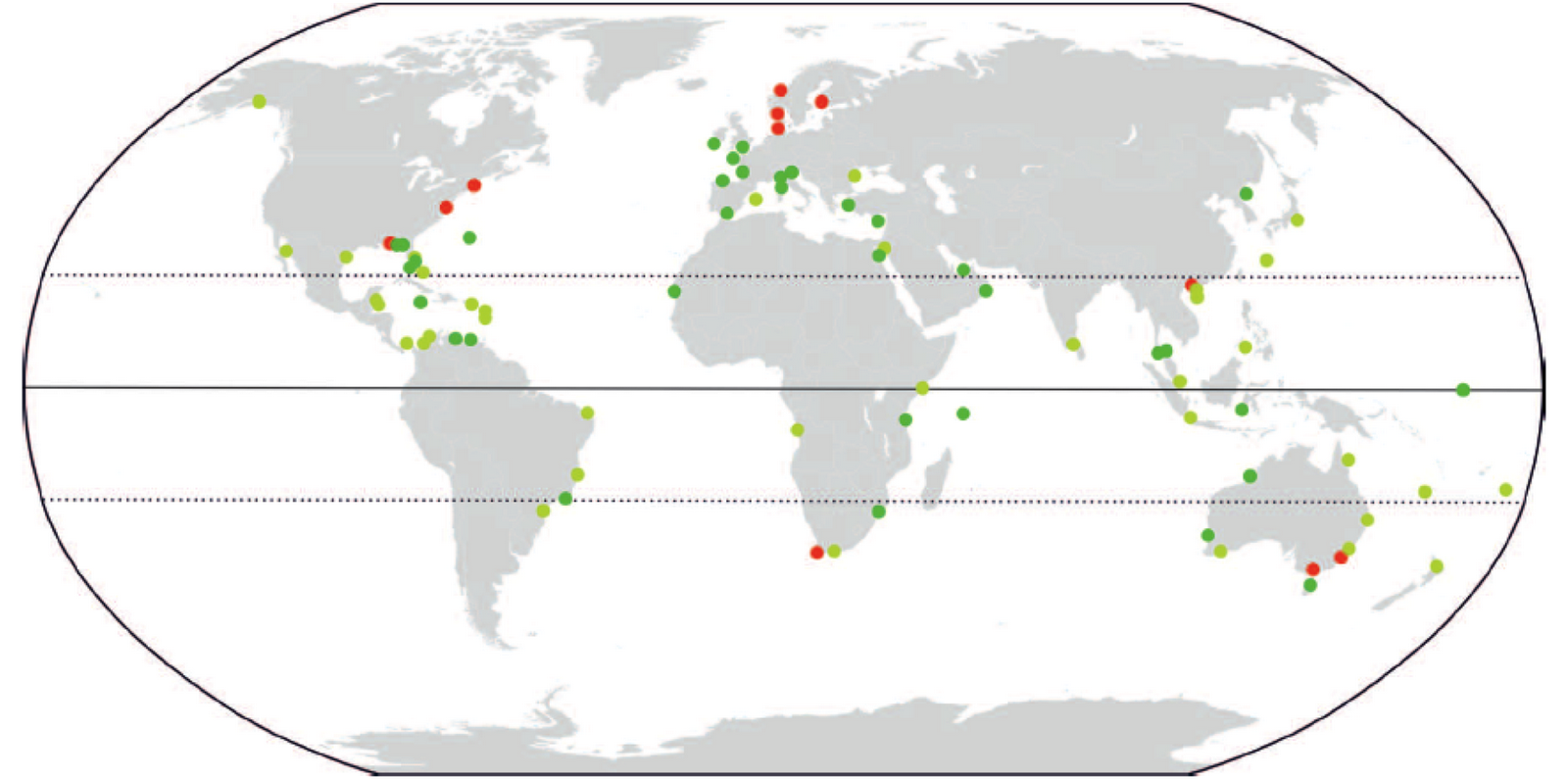
Seagrass meadows are, in contrast, persistent and highly productive, which suggests that there's more than oxygen transport going on. The paper provides data to show that burrowing Lucinid bivalves commonly co-occur in high abundance with seagrass meadows. And furthermore, the Lucinids increasingly diversified as seagrasses evolved and became more common in the oceans.

A map showing the locations where seagrass occur with (green spots) or without (red spots) lucinid bivalves. The bivalves were present in 97% of tropical, 90% of subtropical, and 56% of temperate seagrass meadows (image taken from the paper).
Lucinids are known to form symbiotic relationships with sulfur oxidising bacteria. The bivalves bring oxygen and sulfides to their gills where the bacteria use them to fuel the production of sugars, which feed them and their bivalve hosts. The paper hypothesises that seagrass also participates in the symbiosis through the transport of oxygen to its roots, which provides ideal conditions for the lucinids and their gill bacteria.

The lucinid bivalve Loripes lacetus (photo idscaro seashell directory)
They tested the hypothesis by growing both a lucinid bivalve (Loripes lacteus) and a seagrass (Zostera noltii) in the laboratory. They examined the effect of sulfide on the bivalve and seagrass when they were both present or when the partner was absent. And their results were intriguing, particularly the effects on seagrass.

The seagrass Zostera marina, which is very similar to Z. noltii (image wikipedia)
The seagrass had greater biomass of both leaves and roots when no sulfide was added and the bivalves had higher weights relative to their shell size when it was. But, when sulfide was added both the seagrass and the bivalve did better when they both occurred together. Interestingly, the seagrass did best when the bivalve was present, but no sulfide was added. This seems to be because sulfide built up in the treatments, even when it was not added.

The results largely confirmed the hypothesis that there is a three species symbiotic relationship. Seagrass benefits from the removal of sulfide by the bacteria-bivalve symbiosis and the bivalve benefits from the oxygen provided by the seagrass. Furthermore, in the wild the bivalve may benefit from the presence of seagrass because seagrasses indirectly stimulate sulfide production by accumulating organic matter in the soils beneath the growing meadows.

The results have potentially significant implications for seagrass conservation. Many conservation projects attempt to restore lost seagrass meadows by moving plants from other locations were they're doing well. But, the results of this procedure are mixed. This research suggests that moving the bivalve as well as the seagrasses might lead to greater success.
Tjisse van der Heide, Laura L. Govers, Jimmy de Fouw, Han Olff, Matthijs van der Geest, Marieke M. van Katwijk, Theunis Piersma, Johan van de Koppe, Brian R. Silliman, Alfons J. P. Smolders, & Jan A. van Gils (2012). A three-stage symbiosis forms the foundation of seagrass ecosystems Science, 336 (6087), 1432-1434 DOI: 10.1126/science.1219973

Tuesday, July 10, 2012

Arsenic life not based on arsenic...

Few people who read popular science websites would be unaware that about this time last year a paper was published in Science that claimed a bacteria could incorporate arsenic into its DNA. The paper sparked a storm of controversy for the way the news was announced at a press conference and for the way that the science was done. The lead author, Felisa Wolfe-Simon, NASA (who funded the research) and even Science took flak for the publication of the paper (see Carl Zimmer's compendium of critical responses).

Now one of the most vociferous critics, Rosie Redfield, has published a paper with a team of other researchers that has failed to replicate the results of the initial paper. Another team has also published a paper alongside the Redfield paper. They too, failed to reach the same results as Wolfe-Simon. The conclusions of both the new papers were essentially the same; there was enough phosphorous in the medium to allow the bacteria to grow and there was not arsenic in its DNA.

But, it is apparently not the end of the saga. Felisa Wolfe-Simon has stated that the two new papers "are consistent with our original paper". The new results are completely at odds with the claims made in the initial paper, so it'll be interesting to see how she demonstrates that there are no discrepancies. She has promised that she and her collaborators will have a new paper out in the next few months.