Showing posts with label climate change. Show all posts

Monday, April 15, 2013

The resilience of coral reefs

ResearchBlogging.orgMany people are justifiably concerned with the potential impacts of climate change and ocean acidification on coral reefs. But, coral reefs have been declining for at least the last 25 years and probably much longer, overwhelmingly due to threats that are unrelated to climate change. If we do not address these impacts we will continue to lose coral cover and reefs will be more vulnerable to climate change and ocean acidification.

A coral outcrop on the Great Barrier Reef (photo Wikipedia)
A new paper serves as an illustration of how resilient coral reefs are to climate impacts when they are isolated from other anthropogenic impacts, such as overfishing and agricultural runoff. James Gilmour and other researchers from the Australian Institute of Marine Science and some from the Centre of Excellence for Coral Reef Studies followed the recovery of the Scott Reef system after a catastrophic bleaching event in 1998 that reduced coral cover from 50% to 10%. There was great concern for the reef system because it was isolated from other reefs that could supply coral larvae to fuel recovery.

The Scott Reef system. The crescent shaped reef at the bottom is Scott Reef South, the small reef above the left arm of the crescent is Scott Reef and the pear shaped reef is Scott Reef North (photo Wikipedia).
It turns out that, on balance, the isolation was a good thing. The supply of coral larvae reaching the reef was less than 6% of what it was prior to the bleaching event for six years. But, the reef was also isolated from chronic anthropogenic pressures, particularly overfishing. The number of herbivorous fish was already high at the time of the bleaching and jumped afterwards. As coral cover increased the numbers of herbivorous fish declined back to what they were prior to the bleaching.

The daisy parrotfish, Chlorurus sordidus, is an important herbivore on coral reefs (photo Dennis Polack, EOL).
The herbivorous fish kept seaweed and other organisms that compete with coral from taking over. Remnant corals that survived the bleaching were able to grow quickly and the small numbers of coral larvae reaching the reef had unexpectedly high survival. The fast growth of existing coral drove the initial recovery of the reef. Once young corals became established and began reproducing the supply of larvae increased and the recovery of coral cover accelerated.

Ten years after the bleaching event the supply of coral larvae had returned to the levels seen before the bleaching. Two years later the amount of coral cover and community structure on the reef had largely been restored. The rate of recovery is made more remarkable by the occurrence of a second more moderate bleaching event, two cyclones and a disease outbreak.

The study highlights just how resilient coral reefs can be to the effects of climate change and other disturbances if chronic anthropogenic stress is low. Overfishing, sedimentation and pollution are causing severe declines in coral cover right now. If we can control these threats, coral reefs might be able to survive in a warmer, more acidic ocean.

Reference:
Gilmour, J., Smith, L., Heyward, A., Baird, A., & Pratchett, M. (2013). Recovery of an Isolated Coral Reef System Following Severe Disturbance Science, 340 (6128), 69-71 DOI: 10.1126/science.1232310

Saturday, February 2, 2013

Attack of the jellyfish swarm

ResearchBlogging.orgJellyfish are not as charismatic as some marine species and consequently they have not received much research attention. Recently though, there has been increasing interest in them because their numbers appear to be on the rise worldwide. There are a few hypotheses about why this might be the case floating around in the literature.

The beautiful and under appreciated jellyfish, Cyanea capillata. Perhaps the World's biggest (photo Wikipedia).
Corals, which are in the same phylum (Cnidaria) as jellyfish, have been on the decline in northern Australia and other parts of the world. Two major hypotheses have been proposed to explain this; overfishing reducing herbivorous fish numbers leading to algal overgrowth and agricultural runoff decreasing water clarity through sedimentation and by promoting phytoplankton growth. These same pressures are thought to have a positive effect on jellyfish populations.

Overfishing is argued to increase jellyfish numbers by reducing predation and competition for food, particularly of young jellyfish. While agricultural runoff stimulates phytoplankton blooms that directly or indirectly provide increased amounts of food to jellyfish. Some others argue that changes to marine communities that are occurring as a result of climate change are tipping the ecological balance in favour of jellyfish. But there isn't much agreement, even among experts, about whether jellyfish have actually increased globally.

Nomura jellyfish, Nemopilema nomurai, causing problems for Japanese fishermen (Photo Shin-ichi Uye)
Recently, a collaboration of scientists from around the world have conducted one of the most comprehensive and rigorous analyses of the available data on jellyfish numbers. Condon et al. found that jellyfish numbers go through cyclical population booms roughly every 20 years. Their data suggest that increasing jellyfish numbers in the last few years are simply a part of this 20-year population oscillation. But, there is a hint in the data that since 1970 jellyfish numbers have be increasing.

During the last population minimum, which occurred in 1993, jellyfish numbers were higher relative to previous population minimums. This resulted in a weak, but statistically significant trend towards increasing jellyfish abundance in the last 40 years. The authors caution that the trend is too weak, given the limitations of the data set, to conclude that jellyfish populations really are on the increase. Data collected in the next few years should be able to determine, with confidence, whether the upwards trend is real.

Although they found no strong evidence that jellyfish numbers are increasing worldwide, there was good evidence that numbers are increasing in some regions. These regions included the Sea of Japan, North Atlantic shelf regions, the Barents Sea, and parts of the Mediterranean Sea. All of these regions exhibited the 20 year oscillation, but local factors seem to have acted in concert with the global population fluctuations. Notably, fishing is heavy in many, if not all, of those regions.

 
Condon, R., Duarte, C., Pitt, K., Robinson, K., Lucas, C., Sutherland, K., Mianzan, H., Bogeberg, M., Purcell, J., Decker, M., Uye, S., Madin, L., Brodeur, R., Haddock, S., Malej, A., Parry, G., Eriksen, E., Quinones, J., Acha, M., Harvey, M., Arthur, J., & Graham, W. (2013). Recurrent jellyfish blooms are a consequence of global oscillations Proceedings of the National Academy of Sciences, 110 (3), 1000-1005 DOI: 10.1073/pnas.1210920110

Thursday, January 31, 2013

Evolution, climate change and coral

ResearchBlogging.orgIncreased carbon dioxide in the atmosphere poses several problems for organisms living in the marine environment. Increases in temperature and ocean acidification are the two best known and most worrying. In order to predict how climate change and ocean acidification will affect marine species, we need to know how they respond to these conditions. The effect of climate change on corals has attracted a lot of attention because of their importance for biodiversity.

We can't just expose corals to predicted conditions because corals of the future won't be naive to these environments and are likely to have evolved. We know that evolution can be extremely rapid, often within decades. Ignoring the potential for evolution to influence the effects of climate change on marine organisms could lead to inaccurate projections of the effects of climate change on extinction risk. Yet many authors are ignoring the effects of evolution and acclimation in making their predictions. 

The three-spine stickleback, Gasterosteus aculeatus has been documented adapting to freshwater conditions from saltwater ancestors in just 13 generations (photo Wikipedia)
In their 2007 paper, Hoegh-Guldberg, et al. dismiss the importance of evolution because "reef-building corals have relatively long generation times and low genetic diversity, making for slow rates of adaptation". But, long generation times are not present in all coral species and the response of corals to climate change is going to depend partly on their algal symbionts, which have short generation times. 

Unfortunately, the rates of evolution in corals and their symbionts are extremely poorly known. In terrestrial systems though, genetic variation for traits related to thermal performance is common and evolutionary responses to changing climate are typical. For instance, changes in allele frequencies consistent with responses to global warming have been documented in a number of insects, such as fruit flies and mosquitoes (e.g. Bradshaw & Holzapfel 2001, Umina et al. 2005).

Acclimation, or phenotypic plasticity, will also affect the way that corals respond to climate change. Plastic responses to the environment can occur within generations and across them. For instance, Donelson et al. (2011) looked at the tropical damselfish, Acanthochromis polyacanthus, and found that their offspring could completely compensate for the negative effects of higher temperatures. But, this only occurred when both they and their parents where reared at the same temperature.


The tropical damselfish, Acanthochromis polycanthus (photo Wikipedia)
There are indications that some acclimation is occurring in corals too. Under stress, corals expel their algal symbionts, which gives them the appearance of having been bleached. Coral reefs that experience greater variability in sea surface temperature and those that have recently been subjected to bleaching are less susceptible to bleaching. This greater resilience suggests that some acclimation to climate change is possible within short time-frames. 

A bleached coral in the foreground with an unbleached coral of the same species behind (photo Wikipedia)
We need a better understanding of how evolution and acclimation may influence the response of corals to climate change so that our predictions are accurate. But, we already know which direction things are probably going to go. John Pandolfi's work has shown that under historical climate change, diversity on corals reefs has declined and populations have moved to higher latitudes (e.g. Pandolfi et al. 2011, Kiessling et al 2012). 

Climate change is currently more rapid than previous episodes and this will limit the amount of adaptation that can occur. Corals are also already under significant pressure from other anthropogenic sources of stress that have resulted in substantial declines and changes in population composition. These pressures, too, will decrease the ability of corals to cope with the effects of climate change. By removing these pressures, we will give corals the best chance possible to adapt to a warmer and more acidic ocean.


Hoegh-Guldberg, O., Mumby, P., Hooten, A., Steneck, R., Greenfield, P., Gomez, E., Harvell, C., Sale, P., Edwards, A., Caldeira, K., Knowlton, N., Eakin, C., Iglesias-Prieto, R., Muthiga, N., Bradbury, R., Dubi, A., & Hatziolos, M. (2007). Coral Reefs Under Rapid Climate Change and Ocean Acidification Science, 318 (5857), 1737-1742 DOI: 10.1126/science.1152509  

Bradshaw, W., & Holzapfel, C. (2001). Genetic shift in photoperiodic response correlated with global warming Proceedings of the National Academy of Sciences, 98 (25), 14509-14511 DOI: 10.1073/pnas.241391498

Umina, P., Weeks, A. R., Kearney, M. R., McKechnie, S. W., & Hoffmann, A. A. (2005). A Rapid Shift in a Classic Clinal Pattern in Drosophila Reflecting Climate Change Science, 308 (5722), 691-693 DOI: 10.1126/science.1109523

Donelson, J., Munday, P., McCormick, M., & Nilsson, G. (2011). Acclimation to predicted ocean warming through developmental plasticity in a tropical reef fish Global Change Biology, 17 (4), 1712-1719 DOI: 10.1111/j.1365-2486.2010.02339.x

Pandolfi, J., Connolly, S., Marshall, D., & Cohen, A. (2011). Projecting Coral Reef Futures Under Global Warming and Ocean Acidification Science, 333 (6041), 418-422 DOI: 10.1126/science.1204794 

Kiessling, W., Simpson, C., Beck, B., Mewis, H., & Pandolfi, J. (2012). Equatorial decline of reef corals during the last Pleistocene interglacial Proceedings of the National Academy of Sciences, 109 (52), 21378-21383 DOI: 10.1073/pnas.1214037110

Wednesday, January 23, 2013

Ed Yong is treading on my turf

Ed Yong is treading on my turf (or should that be seagrass meadow?). Worse though, is that he is doing it better than me...

I have been writing a post about the longevity of coral reefs under future climate conditions. Yesterday, Ed (I hope I can call him that) posted a piece on the future prospects of retaining coral reefs into the next century. You should go read it, but come back in a few days when I post my own piece that will look at the issues from an evolutionary perspective.

*** UPDATE *** I've published my piece.

Monday, December 17, 2012

Shifting baselines in coral cover

ResearchBlogging.orgA great problem for conserving marine ecosystems is that we rarely have a good data on what things were like before human impacts started. In my last post, I wrote about a study that showed that coral cover had declined on the Great Barrier Reef by 50.7% since 1985. At the start of the study coral cover was at 28%, but pristine coral reefs can have over 70% coral cover. This suggests that impacts on the Great Barrier Reef predate the time monitoring started by many years.

A coral outcrop on the Great Barrier Reef (photo Wikipedia)
John Pandolfi at the University of Queensland has been trying to establish the past state of the Great Barrier Reef in numerous ways. One way is to take sediment cores from coral reef and compare the historical diversity and abundance of corals on the reef to the modern community composition. A new study lead by Pandolfi has reconstructed the past coral communities on reefs around Pelorus Island in the Palm Island group. They took cores containing coral remains dating back as far as the mid-third century.

They found that there was a pronounced transition in the coral species on the islands reefs between 1920 and 1955. The transition strongly correlated with a 5 to 10 fold increase in the amount of sediment found in the cores beginning in 1870, but showing several large peaks between the 1920s and 1970s. White settlement and land clearing of the area began in about 1870, the same time that high sediment loads were found in the cores. Prior to that, there was remarkable stability in the coral communities and the amount of sediment reaching the reef.

The new study highlights that reefs in 1985 that were thought to be relatively pristine probably had not been for 50 or 60 years. Therefore attempts to conserve reefs as they were in 1985 is inadequate because these reefs are likely to be already severely impacted by human activities. If we a serious about returning coral reefs to a pristine state, we should be restoring them to what they were like prior to white settlement, not what they were like now after a century of mistreatment.


Roff, G., Clark, T., Reymond, C., Zhao, J., Feng, Y., McCook, L., Done, T., & Pandolfi, J. (2012). Palaeoecological evidence of a historical collapse of corals at Pelorus Island, inshore Great Barrier Reef, following European settlement Proceedings of the Royal Society B: Biological Sciences, 280 (1750), 20122100-20122100 DOI: 10.1098/rspb.2012.2100

Monday, December 3, 2012

Conservation priorities on the Great Barrier Reef

ResearchBlogging.orgA recently published paper on the decline of coral cover on the Great Barrier Reef serves to illustrate an important point; even without climate change we are doing a great deal of damage to some ecosystems. The study by De'ath et al. and published in the Proceedings of the National Academy of Science, finds that coral cover has declined by 50.7% since 1985. They partitioned the losses into 48% tropical cyclones, 42% predation by crown of thorns starfish and 10% to coral bleaching.

The crown of thorns starfish, Acanthaster planci (image Wikipedia)
The declines were not uniform across the reef. Most of the declines were in the southern part of the reef and near to shore, where more people live. Partly this may be due to more frequent storms in the southern part of the reef, but storm frequency has declined in the last 100 years or so. Mostly it's probably because outbreaks of crown of thorns starfish are linked to human activities, such as agriculture and fishing. And these same human activities leave coral less resilient to other impacts and make it more difficult for them to recover from disturbances.

Pollution, sedimentation and overfishing can all change the dynamics of coral reef communities by impairing the ability of corals to recover from other disturbances. Human activities can also increase the mortality of adult coral and reduce the number larvae that survive to become coral. Shifts from coral-dominated communities to seaweed-dominated communities due to these impacts are well documented.

Overfishing, particularly of herbivorous fish, has been strongly linked to shifts in community composition. In direct competition corals lose out to seaweed, which overgrows coral and in some cases uses toxins to kill the coral. Herbivorous fish though, eat the seaweed tipping the balance in favour of the corals. So important are herbivorous fish to corals that some have formed mutualistic relationships with fish, which they signal for help when seaweeds encroach on their space. 

Overfishing has also been suggested to reduce predation on larvae of the crown of thorns starfish, allowing it to reach plague proportions when fish would normally control their numbers. A second hypothesis is that nutrient inputs from farms and cities provides the crown of thorns larvae with large amounts of food, increasing their survival. Neither hypothesis is well supported, but there is growing evidence that both mechanisms are playing a role in crown of thorns outbreaks. 

For corals, like seagrasses, access to light is critical for their survival. Coral derive as much as 90% of their energy from symbiotic algae growing in their tissues. Nutrient inputs and sedimentation reduce the light available to their algal symbionts, which reduces the energy available to them. This can decrease the resilience of corals to other stressors, such as natural disturbance events. The main sources of sedimentation on the Great Barrier Reef are from human activities, such as agricultural run-off and dredging.  

De'ath et al. conclude that there is an urgent need to control crown of thorns outbreaks, especially through improvements to water quality. In the absence of disturbances, the data showed that reefs were able to increase in cover by nearly 3% per year. This is likely to be higher when the full impact of human activities are taken into account. Moreover, their data only go back to 1985, but human impacts on the reef date back to about 100 years before that. The true decline of coral cover on the Great Barrier Reef is, therefore, likely to be far greater than that measured in their study.

De'ath et al. also highlight the impending effects of climate change and ocean acidification. Many people are focused on human emissions of carbon dioxide as the sole problem we need to fix to save the reef. But, it's clear that even without the threats of climate change and ocean acidification the Great Barrier Reef is in great deal of trouble. In order to conserve the reef we need to address the source of these issues now.

De'ath, G., Fabricius, K., Sweatman, H., & Puotinen, M. (2012). The 27-year decline of coral cover on the Great Barrier Reef and its causes Proceedings of the National Academy of Sciences, 109 (44), 17995-17999 DOI: 10.1073/pnas.1208909109

Tuesday, November 13, 2012

More on the iron fertilisation "experiment"

A little while ago I wrote a post on the actions of Russ George, a businessman who has been trying to sell ocean iron fertilisation as a viable method for reducing carbon dioxide in the atmosphere. His arguments about the success of such schemes are way out in front of the science required to support them. He released 100 tons of iron sulfate into the north-eastern Pacific in what he calls an experiment, but what nearly all other pundits have been calling an irresponsible and reckless action.

His supporters have rallied behind him though and have had a presence in nearly every comment thread of prominent science news sites that have covered the issue. So, I thought I would take some time to put my views on the potential dangers of large-scale fertilisation of the ocean with iron.

Phytoplankton is not only reliant on iron to survive. There are several other important nutrients that limit phytoplankton numbers in areas where iron is abundant, such as phosphorous. Large blooms of phytoplankton that are produced by the addition of iron could rapidly deplete other limiting nutrients. Once the bloom has consumed the added iron and collapsed the population may not recover back to what it was prior to the bloom because it is limited by more than iron. 

When the bloom dies and decomposes, it could reduce a molecule that is highly important to a great many marine organisms, oxygen. Areas of the ocean that become so low in oxygen that they are no longer able to support life and know as dead zones. The appearance and expansion of dead zones is often caused in areas where human inputs of important nutrients, such as phosphorus and nitrogen, increases the abundance of phytoplankton. The bacteria that consume the dead phytoplankton also consume the dissolved oxygen, depleting it to levels dangerously low for many other organisms.

The rain of dead phytoplankton could also have serious effects on the seafloor community beneath. Indeed, one of my very first posts on this blog was about how the energy balance in the deep sea was critical to maintaining a high diversity of species in an energy poor, seemingly homogenous environment. A huge input of nutrients from the detritus of a plankton bloom that reaches the seafloor is likely to upset the ecology of the communities found there.

While I think that these are all legitimate concerns, it is important to note that, to my knowledge, none of these effects have been observed in iron fertilisation experiments. Oxygen depletion is a known and well documented effect of phytoplankton blooms. But, iron fertlisation on the scale of Russ George's venture may not be large enough or persist for long enough to have this effect. And natural phytoplankton blooms on the scale of the one observed in the area that George dumped his iron are not unknown.

In fact, some researchers are claiming that the observed phytoplankton bloom was already underway before George released the iron sulfate. Many reports I have read say that that the iron fertilisation occurred in July at the time the plankton bloom was getting started. But, it seems the ship which released the iron sulfate didn't leave port until the 8th of August and probably couldn't have started fertilising until a week later. Natural blooms are known to occur regularly in the area, particularly during summer when offshore currents carry iron-rich water hundreds of kilometers out to sea. Unfortunately, the design of the experiment is so poor that it's hard to tell whether the iron sparked the bloom or how much it contributed to it.


.

Thursday, October 25, 2012

Polar sea ice sets two records

On August 26th this year, Arctic sea ice extent fell to its lowest ever since records began in 1979. Sea ice continued to melt into September reaching a minimum of 3.41 million square kilometers on the 16th of September. Which is 790 thousand square kilometers less than the previous record minimum (2007) and roughly half the average minimum from 1979 to 2000 (7.04 million square kilometers).

At the other end of the planet Antarctic sea ice was setting a new winter maximum of 19.44 million square kilometers on the 26th of September. Which is 740 thousand square kilometers more than the 1979 to 2000 average maximum (18.7 million square kilometers). So the gain in the south is far lower than the loss in the north. And the gain in the Antarctic is no cause for celebration.

Antarctic sea ice extent on the 26th of September when the record maximum was set (image NSIDC)
The gain in sea ice in the Antarctic is likely to be due to two effects. The hole in the ozone layer has a cooling effect on the continent because ozone is a greenhouse gas. Warming in the Southern Ocean, which is well documented, has also lead to an increase in the strength of westerly winds. This has pushed more sea ice away from shore expanding its extent in most places except the Antarctic peninsula where it has decreased.

Wednesday, October 17, 2012

Playing Russian Roulette with Gaia

The addition of iron to the oceans has been suggested as a mechanism to reduce the amount of carbon dioxide in the atmosphere. In several parts of the ocean, plankton abundance in much lower than expected given the availability of nutrients and sunlight. But, these areas are also low in iron, leading many people to suggest that it's the availability of iron that limits plankton numbers. A while ago I wrote about an experiment in the Southern Ocean that investigated this hypothesis. 

Permission to conduct these experiments was hard to get because the UN has agreed to a moratorium on iron fertilisation until more is known about the effects on other marine life. But, in contravention of the moratorium a rogue businessman has conducted an iron fertilisation 'experiment' in the northeastern Pacific, off the coast of Canada. Russ George has been trying to sell his iron fertilisation scheme to the world as part of the lucrative market for carbon credits.

He convinced the Haida Nation to provide one million dollars funding, apparently by telling them that the dumping of iron would increase salmon numbers in the area. With that money he dumped 100 tons of iron sulfate into the ocean 200 nautical miles west of the islands of Haida Gwaii in July this year. The plankton bloom this created reached 10,000 square kilometers in size. In comparison, the experiment in the Southern Ocean dumped just seven tons of iron sulfate and the bloom peaked at 800 square kilometers.

In conducting this 'experiment' Russ George may have broken international and Canadian laws. It violates the UN moratorium on iron fertilisation and he may have committed fraud in obtaining the funds from the Haida Nation. In any case, there is no evidence that plankton blooms will improve salmon number and only limited evidence that iron fertilisation is an effective mechanism for reducing carbon dioxide. And we know next to nothing about the potential negative impacts of such large blooms.

For more information, including Russ George's history in trying to sell iron fertilisation as a carbon credit scheme, try The Guardian and Deepsea News.

Thursday, August 30, 2012

Lowest ever Arctic sea ice cover

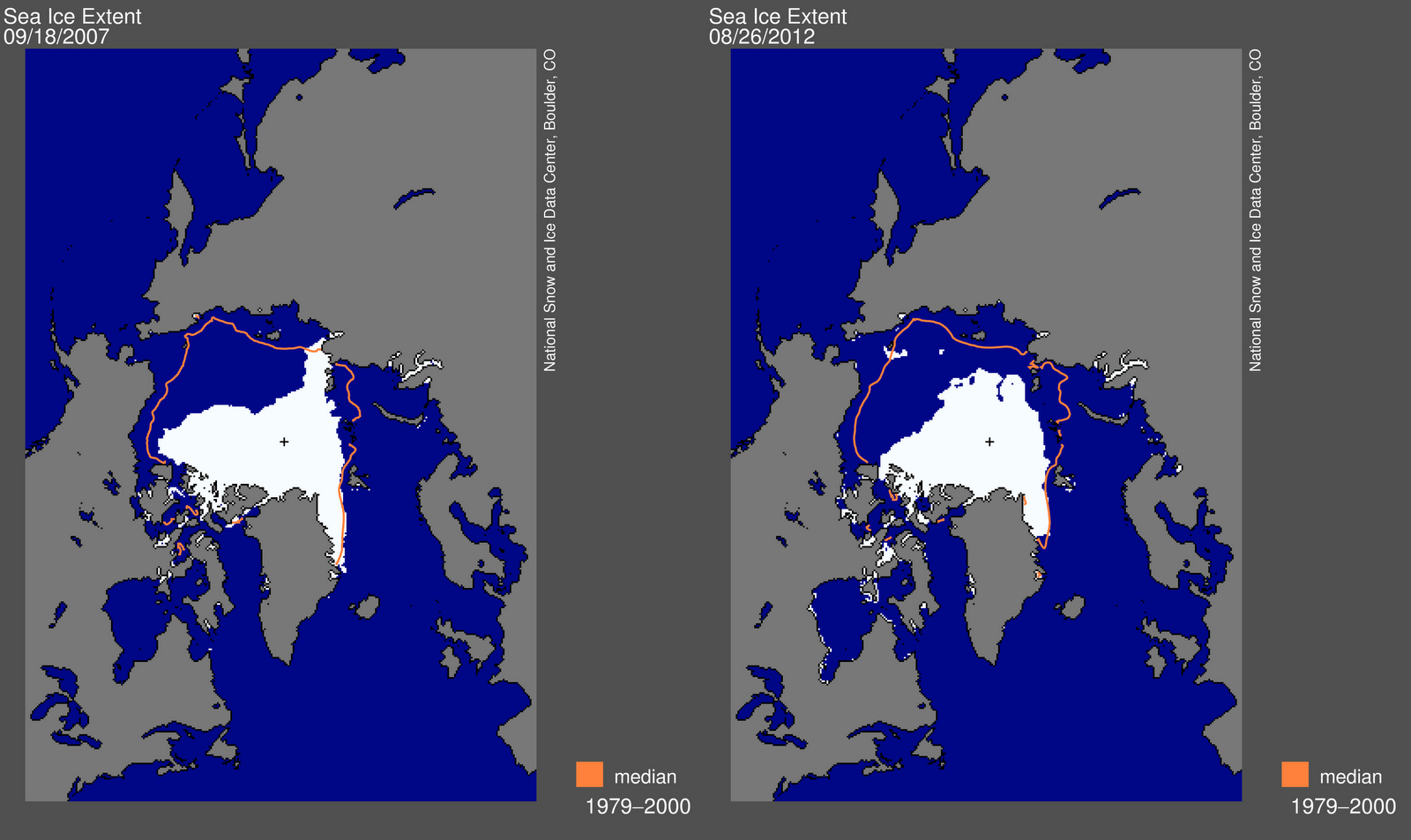
In the northern summer of 2007 the extent of Arctic sea ice reached a low of 4.17 million square kilometers, the lowest since satellite measurements began in 1979. A few days ago the extent of Arctic sea ice was just 4.10 million square kilometers, just breaking the 2007 record. But, the ice is likely to keep melting well into September. 

The minimum sea ice coverage of 2007, recorded on September 18 (left) next to the new record set on August 26 this year (right). Previous years suggest that ice will continue to melt until mid-September (image NSDIC).
Of concern is that this year was cooler than 2007. However, the extent of sea ice coverage measures just two of the three important dimensions. Like its area, the thickness of sea ice has also been falling. This means that the loss of ice area is accelerated because there is a smaller volume that needs to melt. 

Arctic sea ice volume estimated from ice extent and thickness data (image Wikipedia).
The ice loss exposes a greater expanse of open water, which feeds back via two mechanisms to further accelerate ice loss. The sea ice reflects sunlight back into space and as more dark water is exposed more energy is absorbed, which raises temperature. Larger areas of open ocean also allow storms to generate larger waves that break up the ice into smaller pieces, which melt faster.

Of note is that the six years with the lowest Antarctic ice covers are the last six years. Listed from lowest to highest ice cover, they are 2012, 2007, 2011, 2008, 2010 and 2009. To round out the top ten years with the least ice cover add 2005, 2006, 2002 and 2004 to the list. That's right, the top ten years of lowest sea ice cover have occurred in the last eleven years. And 2003 sits at number twelve after 1995.

Monday, August 6, 2012

Playing Gaia

ResearchBlogging.org Phytoplankton doesn't need much to keep it happy. Just some sunlight and a few important macronutrients, such as nitrate, phosphate and silicic acid. However, in some areas of the ocean the abundance of phytoplankton is substantially lower than would be expected from the plentiful supply of nutrients. Such areas are known as "high-nutrient, low-cholorophyll" (HNLC) regions and make up 20% of the ocean surface.

Diatoms make up a large part of the phytoplankton (photo Wikipedia)
A feature often associated with HNLC regions is the low bioavailability of iron. Iron is critical for phytoplankton as it is required to make chlorophyll and important enzymes like nitrate reductase. It has, therefore, been suggested that iron bioavailability is the most important factor limiting phytoplankton population size in HNLC regions. But, zooplankton grazing and deep mixing of surface water that reduces the time that phytoplankton has access to light have also been hypothesised.

Progression of the largest recorded natural phytoplankton bloom in the Southern Ocean, which occurred earlier this year. It was thought to be caused by the addition of iron blown into the sea by strong offshore winds. At its peak, it measured 100 km north-south and 200 km east-west (images Jan Lieser & NASA Terra Modis).
A study, published in Nature, investigated the effect of adding iron to the water on phytoplankton abundance. It was not the first experiment to do so, there have been several. But, unlike the others, this experiment showed that much of the dead phytoplankton was transported into the deep sea. Which is important for our understanding of the role that the ocean plays in regulating the climate.

A map showing the location of iron fertilization experiments. The experiment published in Nature is the EIFEX study, which is the second from the right (image taken from Baar et al. 2004).
During photosynthesis, phytoplankton consumes carbonic acid, which is formed when carbon dioxide dissolves into water. If sufficient quantities of the carbon that the phytoplankton take up can be transported into the deep ocean, away from the atmosphere, it can effectively reduce the amount of carbon dioxide in the atmosphere, cooling the planet. Indeed, phytoplankton blooms may have played a role in triggering past ice ages.

The study recorded phytoplankton abundance and particles falling beneath the bloom at various depths for 37 days, capturing the rise and fall of the bloom. The bloom peaked after 24 days; chlorophyll concentrations was almost four times those at control sites and the bloom covered nearly 800 square kilometers. As the bloom collapsed, at least half of the biomass sank below 1,000 meters, most of which is likely to have reached the seafloor.

Such evidence indicates that at larger scales and over longer periods, algal blooms could transport climatically significant amounts of carbon into the deep sea. In surface waters, the carbon could be returned to the atmosphere in a few months. But, in deep sea sediments the carbon might not reach the atmosphere for centuries. However, more work needs to be done to confirm the effect of phytoplankton blooms on climate.

A surprising finding of the study was that light availability did not seem to effect the plankton bloom as much as might of been expected. Chlorophyll concentrations remained high down to 100 meters where light availability should limit phytoplankton abundance. Indeed, the results showed that chlorophyll concentrations were similar or higher than those recorded at shallower depths in previous iron fertilization experiments.

Reference:
Victor Smetacek, Christine Klaas, Volker H. Strass, Philipp Assmy, Marina Montresor, Boris Cisewski, Nicolas Savoye, Adrian Webb, Francesco d’Ovidio, Jesus M. Arrieta, Ulrich Bathmann, Richard Bellerby, Gry Mine Berg, Peter Croot, Santiago Gonzalez, Joachim Henjes, Gerhard J. Herndl, Linn J.Hoffmann, Harry Leach, Martin Losch, Matthew M. Mills, Craig Neill, Ilka Peeken, Rudiger Rottgers, Oliver Sachs, Eberhard Sauter, Maike M. Schmidt, Jill Schwarz, Anja Terbruggen, & Dieter Wolf-Gladrow (2012). Deep carbon export from a Southern Ocean iron-fertilized diatom bloom Nature, 487 (7407), 313-319 DOI: 10.1038/nature11229

Monday, July 23, 2012

Two's company, three's community ecology

ResearchBlogging.orgA few days ago I wrote about a review paper in Nature Geoscience, which concluded that seagrass meadows were better at storing carbon than terrestrial forests. One of the reasons for this is that, rather than being broken down to carbon dioxide, the organic matter beneath seagrass meadows is broken down anaerobically to hydrogen sulphide.

Hydrogen sulphide is toxic to the seagrass and should build up as more organic matter accumulates over time. Until a new paper in Science, it was unclear how the plants coped with the gas. Seagrasses do transport oxygen to their roots, which is released into the surrounding soil, mitigating against the toxic effects of sulfide. But, sulfide production can outpace the transport of oxygen, especially at higher temperatures, which should result in reduced productivity and mortality. 

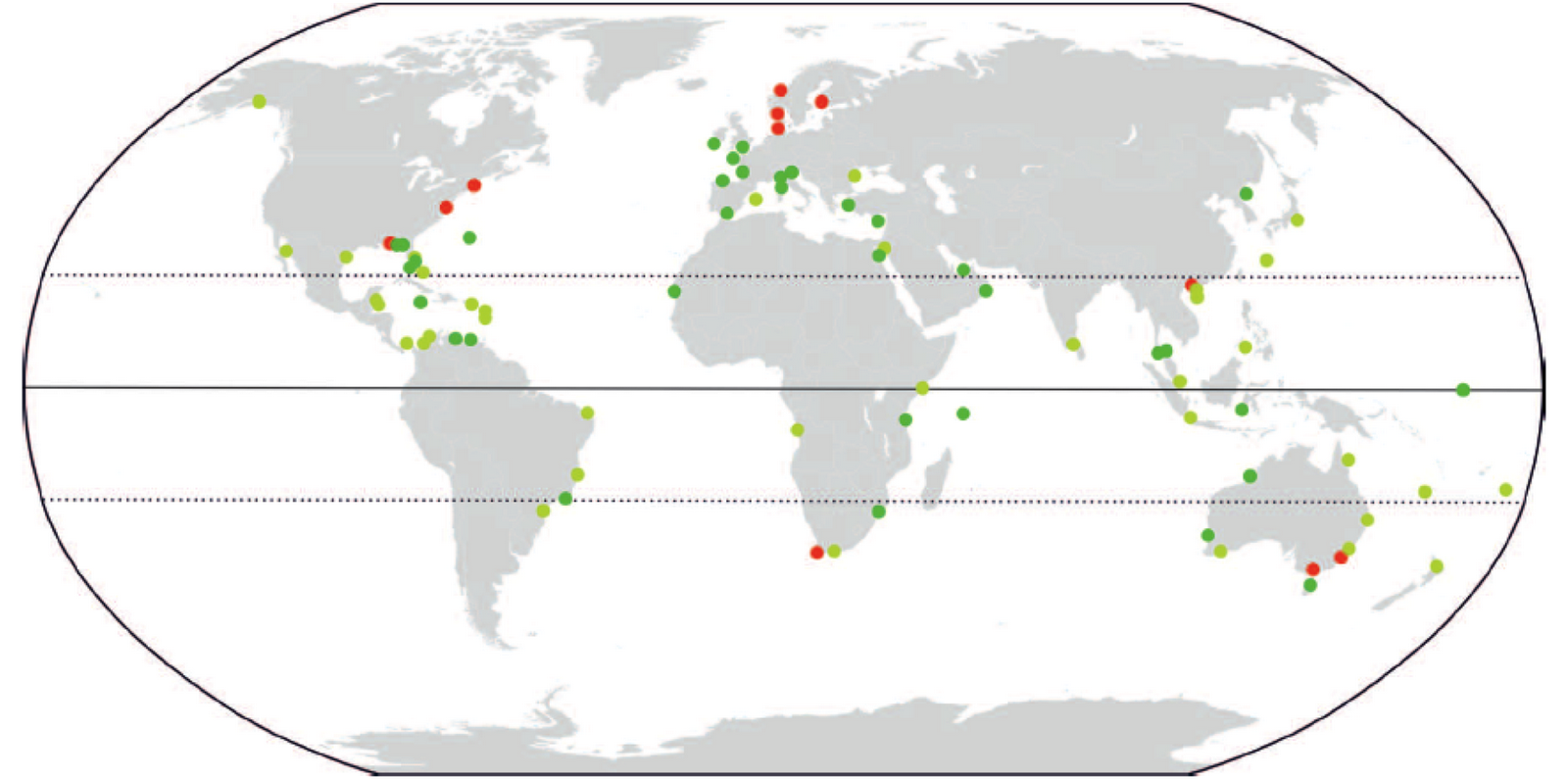
Seagrass meadows are, in contrast, persistent and highly productive, which suggests that there's more than oxygen transport going on. The paper provides data to show that burrowing Lucinid bivalves commonly co-occur in high abundance with seagrass meadows. And furthermore, the Lucinids increasingly diversified as seagrasses evolved and became more common in the oceans.

A map showing the locations where seagrass occur with (green spots) or without (red spots) lucinid bivalves. The bivalves were present in 97% of tropical, 90% of subtropical, and 56% of temperate seagrass meadows (image taken from the paper).
Lucinids are known to form symbiotic relationships with sulfur oxidising bacteria. The bivalves bring oxygen and sulfides to their gills where the bacteria use them to fuel the production of sugars, which feed them and their bivalve hosts. The paper hypothesises that seagrass also participates in the symbiosis through the transport of oxygen to its roots, which provides ideal conditions for the lucinids and their gill bacteria.

The lucinid bivalve Loripes lacetus (photo idscaro seashell directory)
They tested the hypothesis by growing both a lucinid bivalve (Loripes lacteus) and a seagrass (Zostera noltii) in the laboratory. They examined the effect of sulfide on the bivalve and seagrass when they were both present or when the partner was absent. And their results were intriguing, particularly the effects on seagrass.

The seagrass Zostera marina, which is very similar to Z. noltii (image wikipedia)
The seagrass had greater biomass of both leaves and roots when no sulfide was added and the bivalves had higher weights relative to their shell size when it was. But, when sulfide was added both the seagrass and the bivalve did better when they both occurred together. Interestingly, the seagrass did best when the bivalve was present, but no sulfide was added. This seems to be because sulfide built up in the treatments, even when it was not added.

The results largely confirmed the hypothesis that there is a three species symbiotic relationship. Seagrass benefits from the removal of sulfide by the bacteria-bivalve symbiosis and the bivalve benefits from the oxygen provided by the seagrass. Furthermore, in the wild the bivalve may benefit from the presence of seagrass because seagrasses indirectly stimulate sulfide production by accumulating organic matter in the soils beneath the growing meadows.

The results have potentially significant implications for seagrass conservation. Many conservation projects attempt to restore lost seagrass meadows by moving plants from other locations were they're doing well. But, the results of this procedure are mixed. This research suggests that moving the bivalve as well as the seagrasses might lead to greater success.
Tjisse van der Heide, Laura L. Govers, Jimmy de Fouw, Han Olff, Matthijs van der Geest, Marieke M. van Katwijk, Theunis Piersma, Johan van de Koppe, Brian R. Silliman, Alfons J. P. Smolders, & Jan A. van Gils (2012). A three-stage symbiosis forms the foundation of seagrass ecosystems Science, 336 (6087), 1432-1434 DOI: 10.1126/science.1219973

Saturday, July 21, 2012

Seagrass meadows, better than forests

ResearchBlogging.orgI've written before about how amazing seagrass is (part I and part II). A recent paper in Nature Geoscience reviews the published literature on the carbon storage capacity of seagrass meadows. And what it concludes is quite surprising. Per hectare they are better at storing carbon than terrestrial forests despite the insignificant amount of carbon in the plants themselves.

Over time seagrass meadows accumulate large amounts of organic material in soils beneath the growing plants. Part of the soil is formed by dead seagrass, but typically half of the organic material is from other sources that collect in the meadows. The amount of soil that accumulates can be substantial, sometimes forming a layer several meters thick.

The paper looked at published and unpublished data on the organic carbon content of the soils beneath seagrass meadows. They found that the seagrass soils stored almost twice as much carbon as terrestrial soils. Principally this is because the break down of organic matter in seagrass soils occurs anaerobically, which releases hydrogen sulphide, rather than carbon dioxide released in the aerobic break down occuring in terrestrial soils.

Another impressive finding of the review is that carbon stored in the seagrass soils can be stable over thousands of years. This is far longer than carbon can be stored in terrestrial systems, where fires and decomposition eventually liberate the stored carbon back to the atmosphere. However, over the last century nearly 30% of of seagrass meadows have disappeared, most likely causing the release of the sequestered carbon.

Protection and restoration of terrestrial forests is often advocated as a tool for mitigating the effects of climate change. The conclusions of the review paper suggest that restoration and greater protection of seagrass meadows might also be an important tool for reducing the amount of carbon dioxide in the oceans and atmosphere. Intriguingly, deforestation is a threat to seagrass meadows.

Seagrass meadows are exposed to a number of anthropogenic threats. Poor land-use practices, such as deforestation, that increase the silt and nutrient loads that reach seagrass meadows are the most common cause of meadow degradation and loss. Increased turbidity, caused by both silt and nutrient loads, reduces the amount of light penetrating to seagrass meadows. In addition, high nutrient loads can cause the increased growth of epiphytic organisms.

The capacity of marine ecosystems to help mitigate against the effects of climate change is increasingly being looked at. And they are showing that they are not only important pieces in the puzzle, but that they could be more important than terrestrial systems.

James W. Fourqurean, Carlos M. Duarte, Hilary Kennedy, Núria Marbà, Marianne Holmer, Miguel Angel Mateo, Eugenia T. Apostolaki, Gary A. Kendrick, Dorte Krause-Jensen, Karen J. McGlathery & Oscar Serrano (2012). Seagrass ecosystems as a globally significant carbon stock Nature Geoscience, 5 (7), 505-509 DOI: 10.1038/ngeo1477